
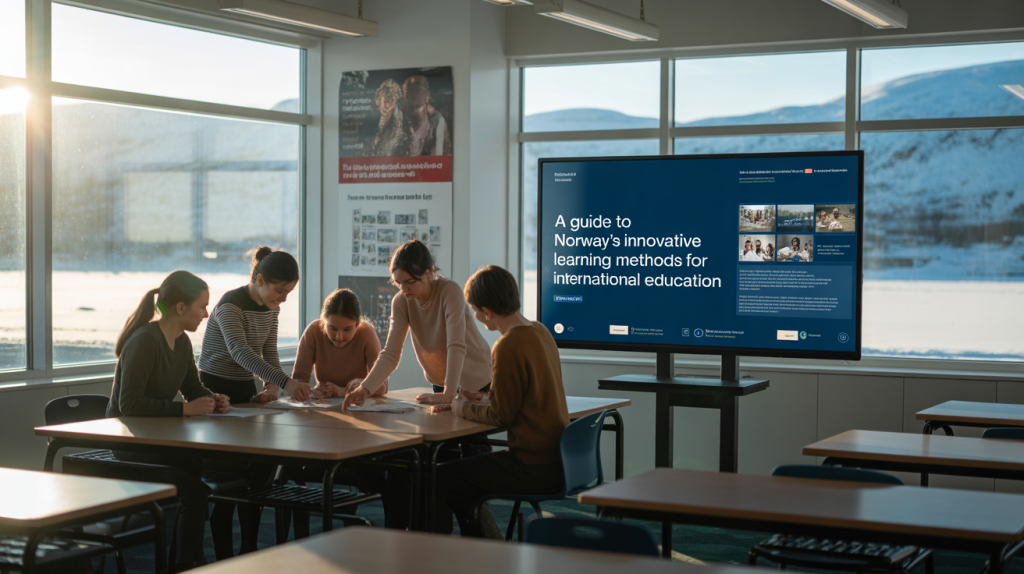
A Guide to Norway’s Innovative Learning Methods: Transforming International Education
Academic Excellence with a Personal Touch
Norway’s higher education institutions maintain a high standard of academic excellence while fostering an accessible, student-friendly environment. One of the cornerstones of Norwegian education is the close, informal relationship between students and faculty. This dynamic encourages open dialogue, enabling students to approach professors comfortably with questions and actively engage in classroom discussions.
- Small class sizes that promote interaction
- Informal teacher-student relationships fostering personalized guidance
- An emphasis on critical thinking beyond rote memorization
Institutions focus on innovative teaching methods that extend beyond traditional lectures. This involves encouraging students to apply knowledge practically, cultivating skills necessary for their future careers.
Collaborative Learning Environments
Collaboration is central to Norwegian education. Universities integrate collaborative projects and group-based problem solving into their curricula – techniques designed to mirror professional settings and develop teamwork abilities.
- Project work across campuses: Students work in diverse groups, often including peers from different disciplines.
- Problem-based learning: Real-world issues serve as the basis for group inquiry and solution development.
- Cross-disciplinary development projects: Encouraging innovation by blending insights from multiple fields.
This collaborative framework nurtures important professional skills such as communication, cooperation, and creative problem-solving, essential for students embarking on global careers.
Technological Integration Enhancing Learning
Norway has successfully embedded advanced technology into its educational system, revolutionizing how learning takes place. Hybrid learning spaces and digital communication tools are widely used, especially in cross-campus programs.
- Synchronous student-centered learning activities spanning multiple locations.
- Sharing of resources between campuses, enabling students to access diverse materials.
- Enhanced communication systems supporting real-time collaboration.
An exemplary case is the Music, Communication and Technology (MCT) master’s program, which blends technical expertise with reflective and critical thinking — embracing the concept of technological humanism.
The Flipped Classroom Model
Many Norwegian institutions utilize the flipped classroom approach, a well-regarded teaching method that enhances student engagement by reversing traditional learning sequences.
- Pre-class preparation with digital learning materials lets students acquire foundational knowledge independently.
- In-class time focuses on interactive discussions, problem solving, and applying what has been learned.
- Common study methods ensure consistent learning experiences across campuses.
This model maximizes the value of face-to-face time by freeing it from passive lecturing to foster active, dynamic classroom interactions.
Student-Active Learning at the Core
Norwegian universities prioritize student-active learning philosophies, which position learners as active constructors of their own knowledge rather than passive recipients.
- Student participation in knowledge creation and critical analysis.
- Engagement with real-world applications, encouraging practical competence.
- Development of independent thinking and problem-solving skills.
This approach ensures students graduate equipped not only academically but also professionally and personally, ready to navigate complex challenges in diverse environments.
Why Partner with Study in Norway?
Understanding Norway’s pioneering learning methods enables recruiters, admissions teams, and educational professionals to better represent the value of Norwegian higher education. At Study in Norway, we specialize in international recruitment and provide advanced solutions tailored to this unique market.
- Strategic support for international student recruitment aligned with Norway’s educational strengths.
- Customized marketing and communication solutions that highlight innovative learning methods.
- Streamlined application and admissions processes to enhance recruitment efforts.
Conclusion: Embrace the Future of Education with Norway
Norway’s innovative learning methods—centered on collaboration, technology, flipped classrooms, and active student participation—set it apart as a leader in global education. These approaches prepare international students not just academically but also professionally and socially.
For institutions and recruiters seeking to expand their international reach, integrating an understanding of these methods into their strategies is essential. Partnering with Study in Norway ensures you have the expertise and tools to attract, admit, and support students who will thrive in Norway’s dynamic learning environments.
Take the Next Step with Study in Norway
Explore further and see how we can assist you in transforming your outreach efforts.